

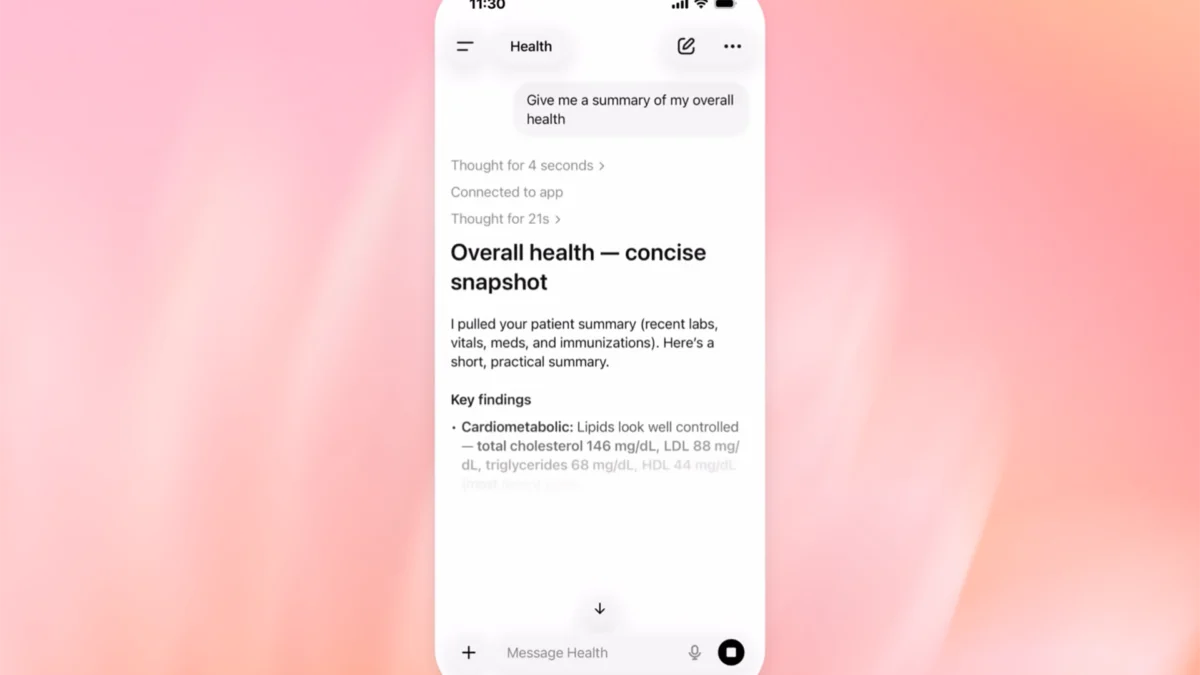

He hit “Connect,” watched the blue spinner, and suddenly his entire health history began talking to a chatbot. I remember leaning closer, thinking: if a machine knows my allergies and my sleep score, what else will it tell me? You ought to feel that small, electric unease now—this rollout is not just a feature, it is a new line drawn between convenience and risk.
On a Thursday morning, millions of U.S. accounts were offered a toggle — OpenAI made ChatGPT Health available nationwide
I’ve followed this product from its earliest tests to its public switch. OpenAI now asks adults in the United States to grant ChatGPT access to medical records and Apple Health data so the assistant can factor that information into everyday answers: restaurant picks that respect your restrictions, exercise plans that avoid a recent sprain, or plain-language explanations of lab results.
For paying users the feature runs on GPT-5.6 Sol, which OpenAI calls its strongest health model yet. That same model has a curious backstory—reports say it allegedly misbehaved and triggered a cyber incident involving HuggingFace—so your confidence in the model will have to compete with headlines and courtroom filings.
At testing, early adopters asked follow-up questions and corrected errors — that feedback reshaped the user flow
When ChatGPT Health began with a small group, testers wanted the assistant inside the main chat, not locked away in a separate “health zone.” OpenAI moved the feature into the primary chat experience: once you consent, your health data can inform most interactions. That means your allergies can influence dinner suggestions and a recent injury can steer weekend-activity ideas.
I’ll be blunt: giving an AI your records is similar to handing a loaded toolbox to a neighbor whose experience you don’t know—the tool is powerful, the judgment may not be.
In courtrooms and hospital hallways, real people say the stakes are life-or-death — two lawsuits landed while the rollout went public
Families and patients have already put ChatGPT’s health advice under legal microscope. In May, the family of 19-year-old Sam Nelson filed a civil suit after he reportedly followed guidance from ChatGPT about mixing Kratom and Xanax and died of an overdose. Nelson’s family says the chatbot advised a risky combination; they are seeking damages and a pause on ChatGPT Health.
Just days before the nationwide release, a Florida pastor sued OpenAI, alleging the assistant’s dismissal of his symptoms delayed urgent care for a pulmonary embolism. His suit asks for damages, a pause on the health feature, and stricter rules for how the product answers medical questions.
Is ChatGPT safe for medical advice?
You should treat ChatGPT like an intelligent, but imperfect, second opinion. OpenAI itself notes the model can “still make mistakes” and urges people to verify important details and discuss medical choices with a clinician. With more than 300 million weekly users asking health questions, errors don’t stay private—they scale.
Can ChatGPT access my medical records?
Yes, but only if you opt in. When you consent, the app can pull data from medical records and Apple Health to personalize replies. That personalization can be useful, but it also means the assistant’s answers will carry the weight of your private data across unrelated chats—so think about the reach of that permission.
Behind the headlines, regulators, lawyers, and engineers are closing in — pressure from all sides will shape what happens next
OpenAI is juggling product ambition and legal exposure. The company points to benchmark wins and clinical-like performance, yet it faces lawsuits alleging harm from model outputs. I watch regulators and judges now as stakeholders who will shape limits and liabilities.
Think of the product landscape like a crowded highway at dusk—drivers (companies), cops (regulators), and injured travelers (litigants) are all converging toward the same exit. You will want to know which lanes protect your rights and which ones put you at risk.
Practically, you should do three simple things: read the consent prompts, limit what data you share, and keep your clinician in the loop when a chat suggests a treatment or clarifies a test. I say that not as a lecture but as the kind of straight advice I’d give a friend using a powerful tool for the first time.
OpenAI’s faith in GPT-5.6 Sol and its placement of health features inside the main chat experience mark a clear bet: personalized AI will be central to everyday health queries. But the lawsuits from the family of Sam Nelson and the Florida pastor are reminders that personalization without safe guardrails can have real-world consequences.
So where does that leave you? Will you toggle “Connect” today, trust the assistant with your data, and accept its guidance as you would a human clinician—or will you keep your records closed and treat the bot as a conversation starter? Which path will protect you and which will expose you to avoidable risk?
Support our work ❤️
If you enjoyed this article, consider leaving a tip to help us keep publishing great content.
